
Walk the Berlin Wall

Details
Led by a 20th century historian, this three-hour walk unravels the complex social, cultural and political history of the Berlin Wall by tracing a section of its former route through the city’s center. In doing so, we will investigate the Post-war background of the Wall’s construction, the physical realities of life in the city that it divided, and the implications of its fall for a reunified Berlin.
Our main goal will be to understand the Wall for what it was: not merely a concrete barrier but also a controlled series of empty spaces and activities (searches, patrols, observations and checkpoints) that came to signify all the consequences of the division of Berlin and of Europe.
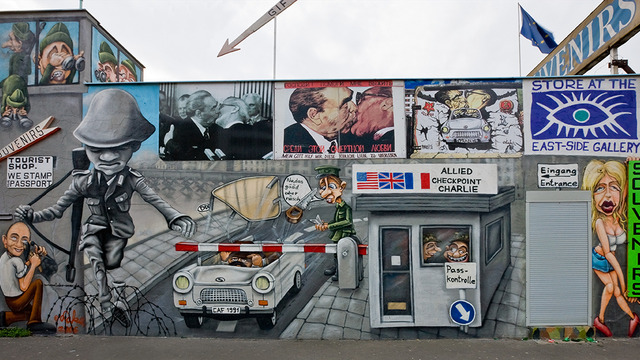
Itinerary
Beginning at the Berlin Wall Memorial in Bernauer Strasse, the site of some of the earliest and most dramatic escape attempts from the communist GDR, we will stop at numerous exhibitions, memorials, artworks and historical locations in order to get a sense of the scale and nature of the city’s division. We will see how the Wall was constructed and expanded, the ways in which it was used as an ideological symbol by Cold War powers, and ultimately how and why it fell. Finally, we will discuss the irony that Berlin is now largely associated with a structure that no longer exists.
The fate of the Wall since 1989 and the debates about place and identity to which it has given rise dramatize the larger issues of national identity in a newly unified Germany. As we pass the many memorializing sites along our itinerary—the “ghost stations” exhibit at Nordbahnhof, Karla Sachse’s artwork Kaninchenfeld (Rabbit Field), a preserved GDR watchtower, and others.
Write a Review