Announcing Gift Cards: Give Happiness!

Just in time for the holidays, we are announcing Vayable Gift Cards! Whether you’re trying to find the perfect gift for your favorite world travelers, urban explorers, or curious knowledge seekers, you can now purchase amazing experiences for them on Vayable.

Whether it’s an invigorating sail on the Mediterranean Sea or a mouth-watering food tour through rich cultures in New York City, there’s something for everyone. Learn more and give a gift now.

Occupy Wall Street - The Revolution Is Love


This is how to live. Our minds and our logic no longer have to fight against the logic of the heart which wants us to be in service. This shift of consciousness that inspires such things is universal in everybody - 99% and 1%. Love is the felt experience of connection to another being. More for you is more for me.

We need each other. This is why Vayable exists. Let’s make it happen.

Good Going: Loving Local Communities

It’s no secret that an active Vayable marketplace keeps local culture alive and helps people make a living doing what they love to do. In comparison to buying things at big box retailers this holiday season, re-directing money to purchasing experiences actually stretches your dollar (or currency of choice) more within the local communities you choose to spend it in.

On Friday, we will launch an exciting new feature that will make it easy for you to appreciate the loved ones in your life and do some good for the local community at the same time! Stay tuned, and in the meantime, have a lovely Thanksgiving!

The Experiential Economy: Can Money Buy Happiness?

We recently read this amazing article on Good that really spoke to us. In the sharing economy, we believe that people will start owning fewer things, buying access to services and re-directing their money to what makes them happy. Happiness research shows that we get longer-lasting meaning and fulfillment from experiences than we do from stuff.

Money can’t buy you happiness, right? Wrong. Kinda.

Wealthier people are indeed happier—but only to a point. All that extra cash buys just a small amount of joy. We quickly get used to having money, it turns out, and we almost immediately start comparing our fancy new toys with our neighbors’.

Psychologists have a found a way to make money-fueled happiness last, however: Buy experiences, not material goods. We adapt to things we do slower than just plain things. We’re also less likely to make social comparisons about trips and meals than cars and gadgets. As a result, experiential purchasers report being more satisfied with their lives, less anxious, less depressed, and in better mental and physical health. - Ravi Iyer

Here is a comparison of purchases on an experiential rating scale. Maybe we’re a bit biased, but we think that unique, local experiences rank quite a bit higher than concerts ;).

From Inside a Government Occupied Favela in Rio

Rio de Janeiro is more than just beaches, warm weather, expansive views, and beautiful people.

One of our new guides, Stewart Alsop III, has an amazing story to share that shows the side of Rio that many people live their everyday lives in but travelers don’t necessarily get to see. He is currently starting an adventure paintball company and living in a favela that will be occupied by the government. He decided stay and develop a business, bringing travelers and adventure seekers to this world. He hopes that people on the outside can get a different point of view than that offered by mainstream media.

He’s chronicling his time there, and here’s a snippet from his blog:

For the past four months I have been living in an unpacified favela, known as Vidigal, located on a hill overlooking the richer parts of Rio de Janeiro. On Sunday, the government will invade this favela, as well as a neighboring one and attempt to establish control over the estimated 450,000 people living in these two areas. Around 2000 troops, with the support of armored vehicles and helicopters, will descend upon Vidigal on Sunday and I will be here.

For those of you that aren’t aware, favelas are informal lower-income neighborhoods that were set up by poor migrants looking for opportunities in the larger cities of Brazil. An unpacified favela is a community that is under direct political control by drug traffickers, not the central government. Almost everyday that I have lived here I see armed men without uniforms. Since Brazil received the 2014 World Cup and 2016 Olympics, the government has slowly and surely established its control over these areas in order to convince the world that it is ready to host these events.

Rio is generally seen as a dangerous city to the outside world, with some justification. My friends living in other parts of the city have been robbed on several occasions and live their lives accordingly; they don’t take out their cell phones in public and never display wealth. My experience in the favela has been completely different. I drive an expensive foreign motorcycle and have no fear of taking out my iPhone or expensive camera. This is because the dono, or leader, of the main drug gangs, enforces his law rigidly, with the help of his managers and street level enforcers. The punishments for theft or rape are harsh and swiftly administered. Unlike the police, who live on $500 a month in the 12th most expensive city in the world, these enforcers and managers are not corrupt. They too know the punishment for inappropriate behavior.

In writing this, I am trying to witness and describe the disappearance of a unique community that is full of contradictions. I have been lucky enough to experience this unique place and want to share what I know before it disappears forever. I am not trying to excuse the drug dealers or portray them in a positive light. They have chosen the life they lead. I only want to bring attention to the majority of the community who are in no way tied to the drug trade. I have lived, travelled and studied in over 45 countries and nowhere else have I encountered such a warm and charismatic people as the ones I have met here in Vidigal.

Read more >>

On Being Inspired by the World Around You

“Travel is more than the seeing of sights; it is a change that goes on, deep and permanent, in the ideas of living.” – Miriam Beard

We’re inspired by the places we explore and the people that we meet there, and our guides feel the same way! Hannah, who organizes a Sunday Drawing by the Beach activity on Vayable shares her story about traveling to India and being inspired by the land, people, and energy of the world around her to create beautiful paintings (featured here in this post).

by Hannah, painter, model, interior designer, Vayable guide in the Los Angeles area

I came to India to travel and to visit my good friend, Lobsang, whom I’ve known for many years. He is a Buddhist monk from the region of northeast India between Bhutan and Tibet, called Tawang. I met him when I was in high school and decided to attend weekly Buddhist sanghas to deal with the pressures of being a teenager. He was always the friend who I would sheepishly go to with “what does it all mean” questions, and the friend I would proudly show off and introduce to my other high school friends as my very own “spiritual mentor”.

Lately he’s transitioned more to the role of “good friend” and “life-consultant”. A few years ago he built a school for orphaned children and village kids who live in extremely dire circumstances, deep in the foothills of the Himalayas, where he grew up. He wanted to provide for children who are living much the same childhood he led until he entered the monastery - a life devoid of parent figures, full of hard manual work (beginning at age 3), suffering abuse, starvation, and lack of any basic hygiene or health care. The school is located in an extremely tiny village with very few people, and is a three day drive from the nearest (slightly bigger village) over waterfalls - that’s right: real, gushing waterfalls which CAN kill you - and the broken down remains of old carrier trucks and military vehicles that did not make it over the narrow roads of the mountain pass.

I traveled to the school with a friend who was teaching English in Asia and wanted to join me in my journey. We intended to spend a week visiting and ended up living there for almost a month, teaching English, some art, some history, and helping to put on a sloppy, but cute Himalayan version of the Ugly Duckling. We also spent time with the live-in, resident teachers discussing their syllabi and the differences between an Eastern and Western approach to teaching and raising children. I think perhaps I learned more from them than they did from us!

The location was incredibly beautiful - saddled between Bhutan and the beginnings of the Himalayan steps toward middle Tibet, we were literally in the clouds. Sitting on the side of the hill, listening to the monkeys rustling the trees in the nearby jungle, watching the clouds slowly envelop the jutting peaks in the distance and smelling the nag champa incense burning for evening prayer (in English, Tibetan, Hindi, and the native language of Tawang), I truly felt that I was in Heaven.

I sketched the face of every kid at that school, but I did not truly start painting until I traveled back to grimy, hot, jungly, bustling Delhi. For me, Lobsang’s school was too perfect, too beautiful. It was the areas on the way from Bengal to Delhi and in western Rajasthan that truly inspired me to make paintings. There was something to the way people lived in these areas - literally on top of each other and yet, to some extent, in harmony. They bathed openly in the lakes surrounding tourist-ridden Jodhpur architectural ruins; they laid out fabric at night and slept alongside each other in groups of over a hundred on the train platform and shaved over the tracks in the morning while waiting for the express train.

The presence of people was everywhere: in the embers and smells of the burning trash piles on the corner of the street, in the Tibetan scrawlings on the side of a road-side shack from Kathmandu to Darjeeling, in the candle-lit Hindu altar seen through a crevice in the crumbling wall of the Red Fort in Delhi. And the colors were enough to throw my painter’s brain into a tail-spin. I feel sympathy for artists who visit this area of the world - there is simply TOO MUCH to take in. I fell in love with the orderly chaos of life in these places that I visited. In this work I want to show people a view of the world that may not be easy to look at, but perhaps is the best view for us to see.

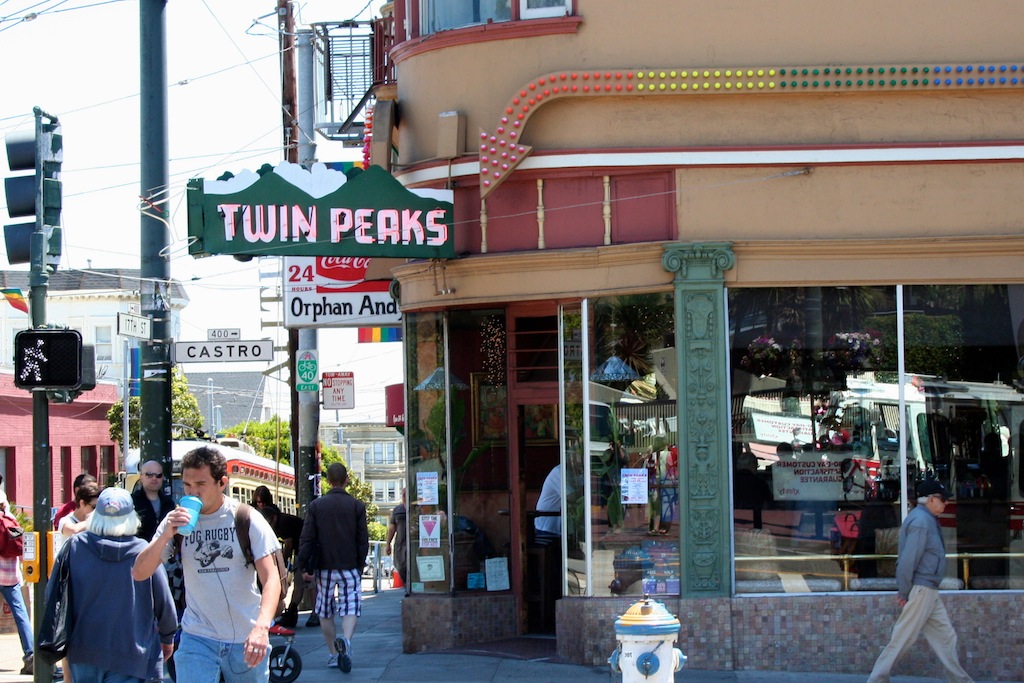
Castro Cultural Bar Crawl in San Francisco

Beneath the fabulous dance music, clever puns, and rose colored drinks is a district full of history. Stories from the past are told through the establishments that are still standing and the culture that exists today. Twin Peaks, on the corner of Castro and Market, was the first gay bar in the nation with large glass windows on all sides, symbolizing a sense of transparency and openness. Harvey’s has a long history and was raided by the police in the Harvey Milk days.

Over time the district has overcome many struggles, led by a sense of community and love, to become what it is today. Now the Castro is not only tolerant but celebratory of a thriving gay culture, a destination for the GLBT rights supporters around the world. Jeremy offers a Castro Culture Bar Crawl in San Francisco so that anyone can instantly become part of the culture, life, and community in the Castro.

We experienced the crawl ourselves and can assure you that this one is worth it. Jeremy moved to San Francisco from Kansas (after a stint in Washington DC) and finds himself making a living by participating in the sharing economy, doing tasks on TaskRabbit and leading tours on Vayable in this down economy. Here’s what Jeremy has to say about his experience:

I thought that posting an experience on Vayable would be a fun way to meet interesting people from all around the world. Everyone wants to travel and experience the places they go as a local, and it was the perfect venue.

People should go on my tour because everyone should step into my shoes at least once and experience the fabulousness that is life in SF. I’m from Kansas. There isn’t much of a gay scene in Kansas. People are fairly accepting, but it doesn’t mean that there will be parades or lots of gay bars anytime soon.

The moment I fell in love with San Francisco: It was an amazingly warm Sunday in Feburary and I wasn’t looking forward to going back to DC, which was still in the middle of a deep freeze. I was sitting in Dolores Park waiting for a few friends, and I decided right then and there to move to SF. So I pulled out my iPhone and bought a one-way plane ticket!